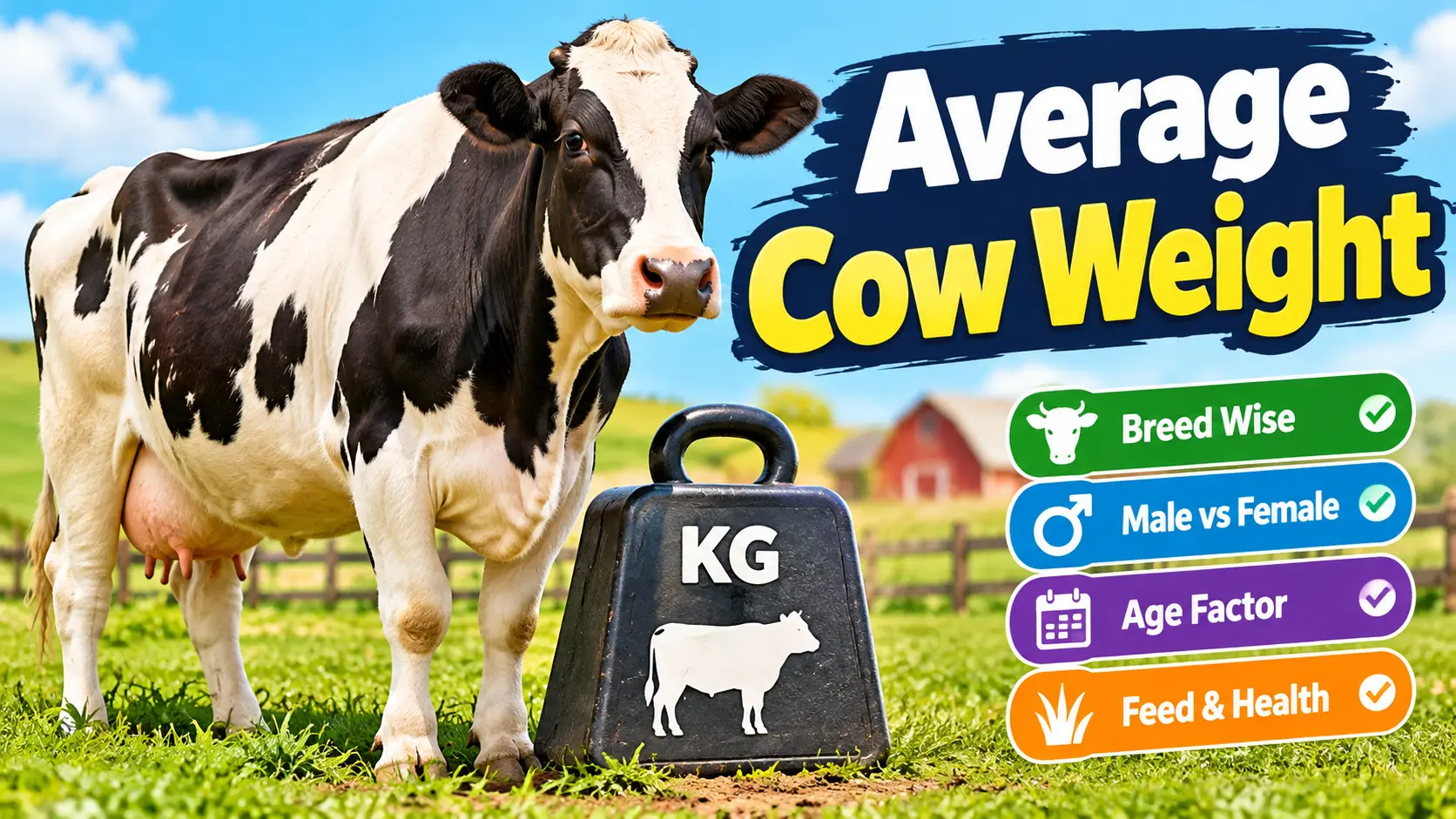
The average cow weight is usually between 1,000 and 1,400 pounds (454 to 635 kg) for many mature cattle breeds. However, there is no single weight that applies to every cow. Breed, age, genetics, sex, nutrition, pregnancy, and body condition can all make a significant difference.
For example, a mature cow from a large beef breed may weigh well above 1,400 pounds, while a smaller dairy or indigenous breed may weigh considerably less. A mature bull is also generally much heavier than a cow. According to the University of California Agriculture and Natural Resources, cows of many cattle breeds weigh approximately 1,000 to 1,400 pounds, weaned calves commonly weigh 500 to 700 pounds, and bulls weigh about 1,800 pounds.
So, if you are searching for how much does a cow weigh, the best answer depends on what type of cow you mean. This guide explains the average cow weight in pounds and kilograms, compares common breeds, looks at cow weight by age, explains the difference between beef and dairy cattle, and shows how farmers can estimate cattle weight without a livestock scale.
Quick Answer:
For a general reference, a mature cow commonly weighs about 1,000 to 1,400 pounds, or approximately 454 to 635 kg. This range is useful for many cattle breeds but should not be treated as a universal breed standard.
Here is a quick overview:
| Cattle Type | Approximate Weight |
| Small mature cow | 700–1,000 lb (318–454 kg) |
| Typical mature cow | 1,000–1,400 lb (454–635 kg) |
| Large mature cow | 1,400–1,700+ lb (635–771+ kg) |
| Weaned calf | 500–700 lb (227–318 kg) |
| Mature bull | Around 1,800+ lb (816+ kg) |
These are broad reference points. A breed-specific figure is usually more useful when you need to know the expected weight of an individual animal.
Average Cow Weight in Pounds and Kilograms
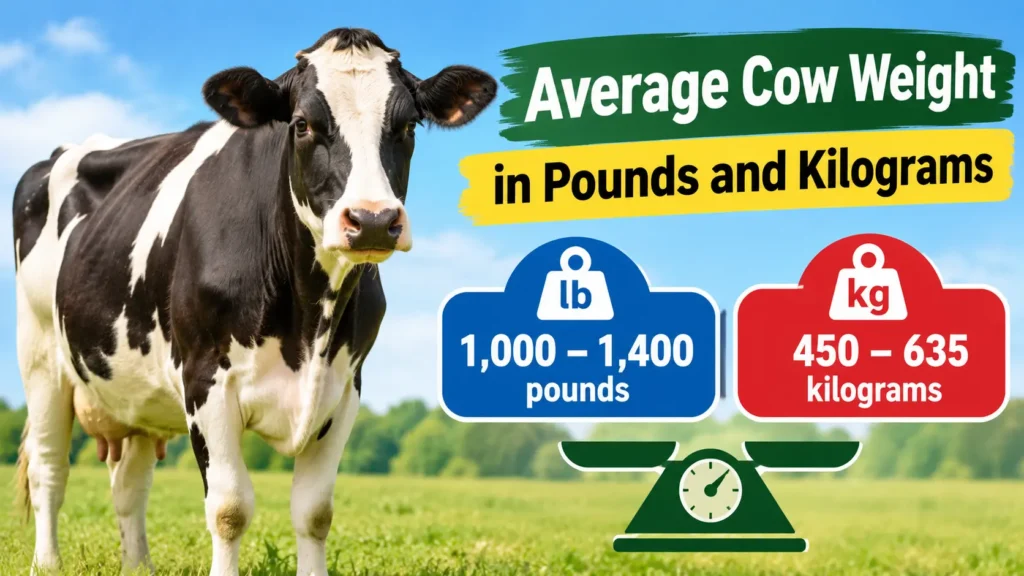
People in different countries commonly measure cattle using either pounds or kilograms. Knowing both measurements makes it easier to compare cattle breeds and livestock information.
The most useful general conversion is:
1 pound = approximately 0.454 kilograms
Therefore:
- 700 pounds ≈ 318 kg
- 900 pounds ≈ 408 kg
- 1,000 pounds ≈ 454 kg
- 1,200 pounds ≈ 544 kg
- 1,400 pounds ≈ 635 kg
- 1,600 pounds ≈ 726 kg
- 1,800 pounds ≈ 816 kg
When someone asks about cow weight in kg, a mature cow may commonly fall somewhere around 454 to 635 kg, but smaller and larger breeds can fall outside that range.
The University of California’s general cattle guidance places many mature cows between 1,000 and 1,400 pounds.
Average Cow Weight by Breed
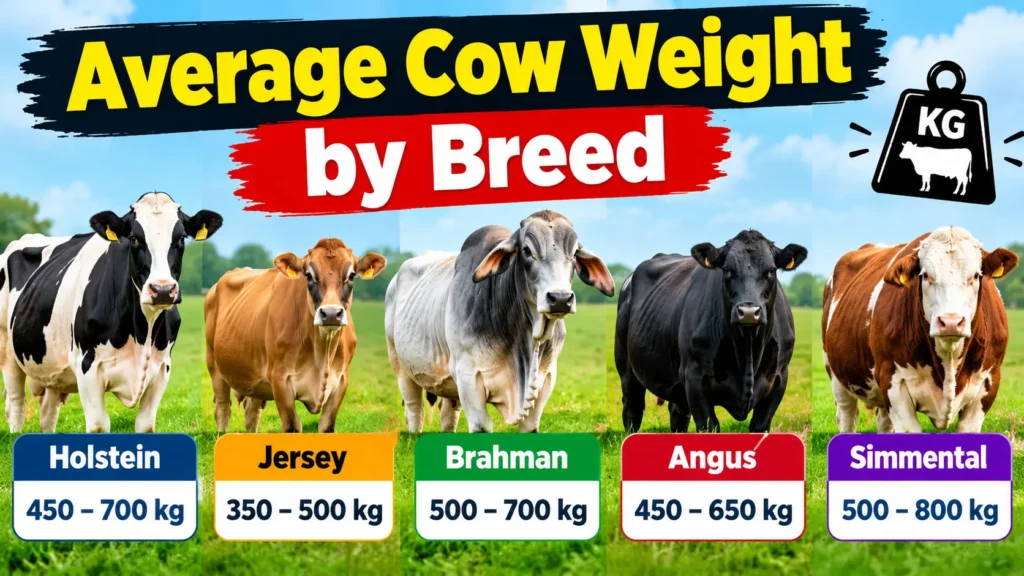
Breed is one of the most important factors affecting adult cattle size.
Cattle have been selectively bred for different purposes. Beef breeds are often selected for growth and muscle development, dairy breeds for milk production, and some indigenous breeds for their ability to survive and produce under challenging environmental conditions.
As a result, the average cow weight by breed can vary by hundreds of pounds.
Angus Cow Weight
Angus is one of the most widely recognized beef cattle breeds. Mature Angus cows are generally medium-to-large beef animals, although their exact weight varies among genetic lines and management systems.
A commonly referenced mature Angus cow weight is around 1,100 pounds, or approximately 499 kg.
The actual weight of an Angus cow may be higher or lower depending on age, frame size, body condition, pregnancy, and nutrition.
For commercial cattle producers, the goal should not simply be to produce the heaviest Angus cow possible. Mature size should be balanced with fertility, longevity, feed requirements, and productivity.
Hereford Cow Weight
Hereford cattle are another major beef breed. Mature Hereford cows can fall within the general 1,000-to-1,400-pound range, although individual animals and genetic lines can vary.
Research cited by the University of Georgia Cooperative Extension illustrates how even Hereford cow weight can vary substantially according to selection and herd type. In one comparison, average cow weights were approximately 953 pounds for unselected Herefords, 1,168 pounds for selected Herefords, and 1,234 pounds for crossbred cows.
This is an important reminder that a breed does not have one fixed weight. Genetics and selection within a breed can change mature size considerably.
Charolais Cow Weight
Charolais is a large beef breed known for its substantial frame and muscular development.
Mature Charolais females can weigh considerably more than the general average for smaller cattle breeds. A commonly cited mature cow weight is around 1,500 pounds, or approximately 680 kg.
Because of their larger frame, Charolais cattle may have greater maintenance requirements than smaller-framed cattle.
Chianina Cow Weight
Chianina cattle are known for their exceptionally large frame and are among the larger cattle breeds.
A mature Chianina cow may weigh around 1,600 pounds, or approximately 726 kg, depending on genetics and management.
This illustrates why a search for average cow weight should always be interpreted in relation to breed.
Brahman Cow Weight
Brahman cattle are particularly well known for their adaptation to hot climates.
Mature Brahman cows can reach approximately 1,400 pounds, although individual animals vary considerably.
Their value is not based solely on body size. Their heat tolerance, environmental adaptability, and usefulness in crossbreeding systems are important characteristics.
Blonde d’Aquitaine Cow Weight
Blonde d’Aquitaine is another large beef breed.
Mature females can weigh around 1,500 pounds, although actual weight varies with genetics, age, nutrition, and body condition.
Large-frame cattle can provide advantages in certain beef-production systems, but producers should also consider feed availability and maintenance costs.
Average Dairy Cow Weight
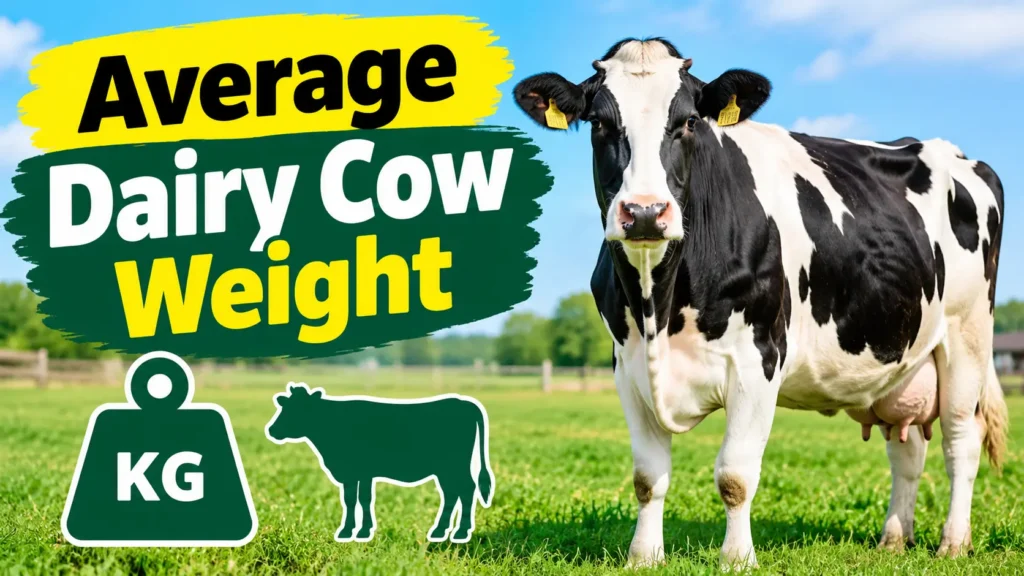
The average dairy cow weight depends strongly on the breed.
Dairy breeds range from relatively small cattle to very large animals. Holsteins, for example, are large dairy cattle, while Jerseys are considerably smaller.
Milk production also affects nutritional requirements. A cow producing large amounts of milk requires substantial energy and nutrients, so body weight should be considered alongside production level and body condition.
When asking how much does a dairy cow weigh, it is therefore important to identify the breed rather than using a single number.
Holstein Cow Weight
Holstein cattle are among the largest and most widely used dairy cattle breeds.
A mature Holstein cow generally weighs well over 1,000 pounds, with actual weight varying according to genetics, age, stage of lactation, body condition, and management.
Holsteins have large frames and high production potential, so their nutritional requirements can be significant.
For dairy producers, monitoring body condition and changes in weight is often more useful than focusing on a single breed-average number.
Jersey Cow Weight
Jersey cattle are smaller than Holsteins and many large beef breeds.
Consequently, the Jersey cow weight is generally much lower than the weight of a mature Holstein.
Their smaller mature size can be useful in production systems where feed resources and space are important considerations.
This comparison also demonstrates why simply asking for the “average weight of a cow” can produce a misleading answer without knowing the breed.
Sahiwal Cow Weight
Sahiwal cattle are an important dairy and dual-purpose breed associated with Pakistan and the Indian subcontinent.
The Sahiwal cow weight varies depending on the population and management system. FAO material reports mature Sahiwal cows at around 300 to 350 kg in a general description of South Asian Zebu breeds.
Another FAO genetic-resources report describes a Sahiwal population in Kenya with mature cow weight around 425 kg, showing why published figures can differ depending on the herd and production environment.
This is an important point when comparing cattle data: a breed’s weight can vary according to genetics, environment, management, and the particular population being measured.
Red Sindhi Cow Weight
Red Sindhi is another important South Asian cattle breed.
FAO information places mature Red Sindhi and Sahiwal cows at approximately 300 to 350 kg in a general breed comparison.
Red Sindhi cattle are valued for adaptation to warm environments and dairy characteristics.
As with Sahiwal cattle, individual Red Sindhi cows can weigh more or less than a general breed estimate.
Tharparkar Cow Weight
Tharparkar cattle are another South Asian breed associated with the region that includes present-day Pakistan and India.
FAO describes Tharparkar as somewhat larger than Sahiwal and Red Sindhi in the same general comparison.
This makes Tharparkar a useful example of how even related or regionally adapted cattle breeds can have different mature body sizes.
Average Cow Weight in Pakistan
The average cow weight in Pakistan cannot be represented by one reliable number because Pakistan has several indigenous breeds and a large population of crossbred cattle.
Important breeds include:
- Sahiwal
- Red Sindhi
- Tharparkar
- Cholistani
- Dhanni
- Bhagnari
- Crossbred cattle
Sahiwal, Red Sindhi, and Tharparkar are particularly important South Asian cattle breeds. FAO reports that mature Sahiwal and Red Sindhi cows average about 300 to 350 kg, while Tharparkar is somewhat larger.
Other Sahiwal populations have been reported with higher mature weights. One FAO genetic-resources report gives a mature cow weight of approximately 425 kg for a Sahiwal herd in Kenya.
Therefore, when researching cow weight in Pakistan, it is better to identify the breed first.
Average Cow Weight by Age
Age has a major influence on body weight because cattle continue growing after birth.
A calf cannot be compared directly with a mature cow, and a two-year-old animal may still be developing toward its mature frame.
Newborn Calf Weight
Newborn calf weight varies according to breed, sex, genetics, nutrition, and the size of the dam.
Large-frame breeds generally tend to produce heavier calves than smaller breeds.
Birth weight is important in cattle management because excessively large calves can contribute to calving difficulty. However, the ideal birth weight depends on the breed and production system.
Six-Month-Old Calf Weight
By six months, calves have usually gained considerably more weight than they had at birth.
Growth depends on milk availability, forage, supplemental feed, genetics, health, and management.
A well-managed beef calf can develop much faster than a calf experiencing poor nutrition or disease.
One-Year-Old Cattle Weight
At one year, cattle are still growing and have not reached mature body size.
Sahiwal research summarized by FAO provides an example of this variation. One dataset reported female Sahiwal live weight of about 142 kg at one year, while other studies have reported somewhat different values.
This illustrates why age-specific weight should always be connected to a particular breed and production environment.
Two-Year-Old Cow Weight
At two years, cattle are approaching mature size but may continue growing.
FAO data for Sahiwal cattle report a female live weight of approximately 252 kg at two years in one dataset. Other populations may be heavier or lighter.
Large-frame beef breeds can have considerably higher weights at the same age.
Mature Cow Weight
Mature weight depends on breed, genetics, nutrition, and management.
For many cattle breeds, a mature female weighing 1,000 to 1,400 pounds is a useful broad reference, but large breeds may exceed that range while smaller indigenous breeds may be substantially lighter.
Cow Weight by Age: Simple Reference Table
Because growth varies so much among breeds, an age table should be treated as a guide rather than a universal standard.
| Age/Stage | General Weight Pattern |
| Newborn | Highly breed-dependent |
| 6 months | Rapidly growing calf |
| 1 year | Substantial growth but immature |
| 2 years | Approaching mature frame |
| Mature cow | Often 1,000–1,400 lb for many breeds |
| Mature large-frame cow | Can exceed 1,400 lb |
For accurate growth monitoring, farmers should compare an animal with breed-specific benchmarks rather than relying only on a general cattle-weight chart.
Average Bull Weight vs. Cow Weight
The average bull weight is generally greater than the average female cow weight.
Bulls are mature intact males and typically have larger frames, greater muscle mass, and greater body weight.
For many cattle breeds, a mature bull may weigh around 1,800 pounds, compared with approximately 1,000 to 1,400 pounds for many mature cows.
However, bull weight also varies significantly by breed.
A large beef bull may weigh considerably more than a bull from a smaller breed.
Average Calf Weight
The average calf weight depends on age and breed.
For weaned calves, a general reference range is approximately 500 to 700 pounds, according to University of California Agriculture and Natural Resources.
This does not mean every weaned calf should weigh within this range. Calves may be lighter or heavier depending on:
- Breed
- Sex
- Weaning age
- Genetics
- Milk production of the dam
- Feed quality
- Health
- Growth rate
For commercial cattle producers, monitoring growth over time is more useful than judging a calf by one weight measurement.
What Factors Affect Cow Weight?
Many factors influence the weight of an individual cow.
Breed
Breed determines much of an animal’s genetic potential for mature size.
Large-frame cattle generally have higher mature weights than smaller-frame cattle.
Genetics
Even cattle from the same breed can have different mature weights.
Selection for growth, frame size, muscle, milk production, or other traits can influence the size of future generations.
Research involving Hereford cattle demonstrates that selection and herd type can produce noticeable differences in average cow weight.
Age
Young animals gain weight as they grow. Mature animals may maintain relatively stable weight, although their weight can still fluctuate.
Sex
Bulls generally weigh more than cows because of differences in frame size and muscle development.
Nutrition
Feed availability and quality strongly influence growth and body condition.
Animals receiving inadequate nutrition may grow more slowly and fail to reach their genetic growth potential.
Pregnancy
A pregnant cow can weigh more than the same animal when she is not pregnant because the developing calf and associated tissues contribute to total live weight.
Body Condition
Weight does not tell the entire story.
Two cows with similar frame sizes can have different amounts of muscle and body fat. Body condition scoring is therefore useful alongside weight measurement.
Health
Disease, parasites, poor digestion, dental problems, and other health issues can affect growth and cause weight loss.
A sudden or unexplained reduction in body weight deserves attention.
How Much Does a Cow Eat Based on Its Weight?
Cow weight is useful when estimating feed requirements.
The University of California Agriculture and Natural Resources gives approximately 2% of body weight per day in dry matter as a general cattle-feeding reference. Under that guideline, a 1,000-pound cow would consume approximately 20 pounds of dry matter per day.
However, this is not a universal feeding prescription.
Actual intake depends on:
- Forage quality
- Feed availability
- Lactation
- Pregnancy
- Age
- Body condition
- Weather
- Animal size
- Production goals
A high-producing dairy cow can have very different nutritional requirements from a dry beef cow.
Why Is Cow Weight Important?
Knowing cattle weight helps farmers make better management decisions.
Feeding
Body weight provides a starting point for estimating maintenance requirements and planning rations.
Growth Monitoring
Regular weight measurements can show whether calves and young cattle are growing as expected.
Breeding
Weight can help producers monitor development before breeding, although reproductive decisions should not be based on weight alone.
Health Management
Changes in weight can provide an early indication of nutritional or health problems.
Medication
Some veterinary medicines are dosed according to body weight. Accurate measurement is therefore important when following veterinary directions.
Transportation
Knowing the weight of cattle helps producers estimate total trailer loads and remain within appropriate weight limits.
Livestock Marketing
Cattle are frequently sold according to live weight, carcass characteristics, breed, age, and market conditions.
Knowing actual weight can therefore be financially important.
How to Estimate Cow Weight Without a Scale
A livestock scale is the most direct way to measure body weight, but scales can be expensive or impractical for some farms.
A cattle weight calculator or weight tape can provide an estimate when a scale is unavailable.
One common approach uses heart girth, which is the circumference of the animal’s chest behind the front legs.
Modern research continues to show that heart girth can be a useful predictor of cattle body weight. A 2026 study involving thousands of bovine measurements found that heart-girth-based equations can provide useful bodyweight estimates, although accuracy varies by animal, breed, and production system.
This is important because no single formula works perfectly for every cow.
Using a Weight Tape
A cattle weight tape is one of the simplest ways to estimate live weight.
To use one:
- Stand the animal on level ground.
- Keep the animal standing naturally.
- Place the tape around the chest behind the front legs.
- Make sure the tape is snug but not excessively tight.
- Read the estimated weight from the tape.
Weight tapes are designed to convert measurements into estimated body weight.
They are useful for routine management, but they should not be treated as perfectly accurate.
Using Body Measurements
Some cattle-weight methods use both heart girth and body length.
A traditional livestock formula often used for approximate cattle weight is:
Estimated weight in pounds = Heart girth² × body length ÷ 300
For example, if a cow has a 70-inch heart girth and a 78-inch body length:
70 × 70 × 78 ÷ 300 = approximately 1,274 pounds
This type of formula should be regarded as an estimate rather than an exact measurement. The animal’s breed, body shape, age, and condition can affect accuracy.
Recent research also emphasizes that prediction equations may perform differently across breeds and production systems, which is why breed-specific or validated methods are preferable when available.
For medication dosing or other situations where accuracy is critical, an actual livestock scale is preferable.
Cow Weight Calculator: What Information Matters?
A useful cow weight calculator may use one or more of the following:
- Heart girth
- Body length
- Breed
- Age
- Sex
- Body condition
Heart girth is particularly useful because it is relatively easy to measure in the field.
However, calculated weight should always be considered an estimate unless it has been validated for the specific type of cattle being measured.
Average Cow Weight vs. Carcass Weight
Live cow weight is not the same as the weight of meat obtained after processing.
A live animal contains:
- Muscle
- Fat
- Bone
- Hide
- Organs
- Digestive contents
- Blood
- Other tissues
Therefore, a 1,200-pound live animal will not produce 1,200 pounds of packaged beef.
University of California Agriculture and Natural Resources estimates that approximately 50% to 55% of a bovine’s total weight may become consumable product, although actual yield varies by animal and processing method.
This distinction is important for anyone estimating the value of cattle for beef production.
Does a Heavier Cow Mean a Better Cow?
Not necessarily.
A heavier cow may have greater mature size, but larger animals can also require more feed and maintenance resources.
The ideal cow depends on the production environment.
Farmers may need to consider:
- Fertility
- Calving ability
- Longevity
- Health
- Feed efficiency
- Milk production
- Beef production
- Temperament
- Environmental adaptation
- Mature body size
- Body condition
A smaller cow that remains fertile and productive on available feed may be more profitable than a much larger cow with higher maintenance requirements.
The University of Georgia Cooperative Extension’s comparison of Hereford cattle illustrates this tradeoff: higher cow weight does not automatically translate into better production or profitability.
Why Mature Cow Size Matters to Farmers
Mature cow size is an important economic consideration.
Suppose two cows have similar fertility and calf performance, but one is significantly larger. The larger cow may require more nutrients simply to maintain her body.
If feed is inexpensive and plentiful, this may not be a major concern. In areas with limited pasture or expensive feed, however, mature size can have a much larger effect on production costs.
This is why cattle selection should focus on the complete production system rather than weight alone.
Average Cow Weight: Important Breed Comparisons
For a quick overview, the following table shows approximate reference points discussed in this guide:
| Breed/Type | Approximate Mature Female Weight |
| Angus | Around 1,100 lb / 499 kg |
| Hereford | Often around 1,000–1,400 lb, but varies |
| Charolais | Around 1,500 lb / 680 kg |
| Chianina | Around 1,600 lb / 726 kg |
| Brahman | Around 1,400 lb / 635 kg |
| Sahiwal | About 300–425 kg depending on population |
| Red Sindhi | About 300–350 kg |
| Tharparkar | Generally somewhat larger than Sahiwal and Red Sindhi |
| Many mature cattle breeds | About 1,000–1,400 lb / 454–635 kg |
These figures should be used as reference points rather than strict breed standards. Published values can differ because researchers may measure different populations, ages, production systems, and management conditions.
Frequently Asked Questions
How much does the average cow weigh?
Many mature cows weigh approximately 1,000 to 1,400 pounds, or 454 to 635 kg. However, breed and individual characteristics can move the weight significantly outside this range.
What is the average weight of a cow in kg?
A useful general range is approximately 454 to 635 kg for many mature cows. Smaller indigenous breeds and larger beef breeds can fall outside this range.
How much does a beef cow weigh?
Many mature beef cows weigh between approximately 1,000 and 1,400 pounds, but large beef breeds can exceed 1,400 pounds.
How much does a dairy cow weigh?
Dairy cow weight depends on breed. Large breeds such as Holsteins are substantially heavier than smaller dairy breeds such as Jerseys.
What is the average bull weight?
A mature bull may weigh around 1,800 pounds, although breed and individual genetics can produce significant differences.
What is the average calf weight?
Weaned calves commonly weigh around 500 to 700 pounds, although age, breed, sex, nutrition, and management can produce different results.
How much does a Sahiwal cow weigh?
Published Sahiwal figures vary by population. FAO sources report approximately 300 to 350 kg for mature Sahiwal cows in one South Asian breed comparison, while another Sahiwal population was reported at approximately 425 kg mature cow weight.
How much does a Jersey cow weigh?
Jersey cows are smaller than many large dairy breeds, so their mature weight is generally lower than that of Holstein cows.
What is the heaviest cattle breed?
Several breeds have very large mature body sizes. Chianina and Charolais are examples of large breeds, with mature female weights that can be substantially above the general 1,000-to-1,400-pound range.
Can you estimate cow weight without a scale?
Yes. A weight tape or body-measurement method using heart girth can provide an estimate. However, actual scales are more reliable when precise weight is required.
What factors affect cow weight?
The major factors include breed, genetics, age, sex, nutrition, pregnancy, body condition, health, and management.
Final Thoughts
The average cow weight is best understood as a range rather than one exact number. For many mature cattle breeds, 1,000 to 1,400 pounds (454 to 635 kg) is a useful general reference. Weaned calves commonly fall around 500 to 700 pounds, while mature bulls may weigh around 1,800 pounds.
However, breed differences can be substantial. Large beef breeds such as Charolais and Chianina can weigh considerably more than smaller breeds. South Asian cattle such as Sahiwal and Red Sindhi can have much lower mature female weights, with FAO sources reporting roughly 300 to 350 kg for these breeds in one general comparison.