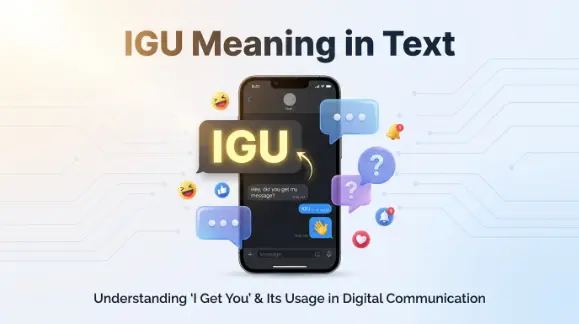
Seeing IGU in a message can leave you wondering what those three letters actually mean. Is the person offering help? Are they saying they understand? Or are they simply giving up? In casual texting, IGU is commonly used for “I Got You.” In that sense, it can communicate support, understanding, reassurance, agreement, or a willingness to help.
For example, if a friend asks, “Can you save me a seat?” and you answer “IGU,” the natural interpretation is “I got you.” However, there’s an important wrinkle. Some current slang references also use IGU for “I Give Up,” especially when someone feels frustrated or defeated. That means you shouldn’t interpret IGU from the letters alone.
Conversation context, tone, and the surrounding messages usually reveal the intended meaning. This guide explains the IGU meaning in text, how the abbreviation works across social media, when to use it, when to avoid it, and how to respond naturally.
What Does IGU Mean in Text?

The most useful interpretation of IGU in a supportive conversation is “I Got You.” It works as a short texting abbreviation for a phrase people already use in everyday spoken English.
Depending on the situation, “I Got You” can mean several closely related things:
- I understand you
- I agree with you
- I will help you
- I’ll handle it
- Don’t worry about it
- I support you
- I’ve got your back
- I can help
- I’ll take care of it
- Okay, understood
- Yes, that works
- Consider it done
The exact IGU meaning in text depends on what came before it.
For example, consider this exchange:
Friend: “Can you send me the notes tonight?”
You: “IGU.”
Here, IGU means something close to “I got you. I’ll send them.”
Now change the conversation:
Friend: “I don’t know what you’re saying, but I understand your point.”
You: “IGU.”
In this setting, the phrase can communicate “I get you” or “I understand what you mean.”
There’s also another documented interpretation:
IGU = I Give Up
That version fits situations involving frustration, defeat, or surrender. For example:
“I’ve tried solving this puzzle for an hour. IGU 😩”
Here, the intended meaning is likely “I give up.”
Because both interpretations exist in current online usage, context matters more than any rigid dictionary-style definition.
Simple Examples
Here are some IGU examples that show the supportive meaning:
“Can you pick up groceries?”
“IGU.”
Meaning: “I’ll take care of it.”
“I’m nervous about the presentation.”
“IGU. You’ll be fine.”
Meaning: “I support you. Don’t worry.”
“Can you save me a seat?”
“IGU 👍”
Meaning: “I got you.”
“This level is impossible. IGU 😭”
Meaning: “I give up.”
That last example demonstrates why reading the entire exchange matters.
What Does IGU Stand For?

In casual online slang, IGU can stand for “I Got You.” It compresses a familiar phrase into three letters, making it convenient for fast digital conversations.
However, IGU abbreviation meaning isn’t completely universal. Current online slang references also document “I Give Up” as another interpretation.
So, if someone asks “what does IGU stand for?”, the safest answer is:
IGU can mean “I Got You” or “I Give Up” in informal online communication. The context determines which meaning applies.
Outside internet slang, the letters can represent unrelated technical terms. For example, in construction and window manufacturing, IGU can mean Insulated Glass Unit. That technical meaning has nothing to do with texting slang.
Therefore, always consider where you encountered the term.
IGU Meaning in Text From a Guy
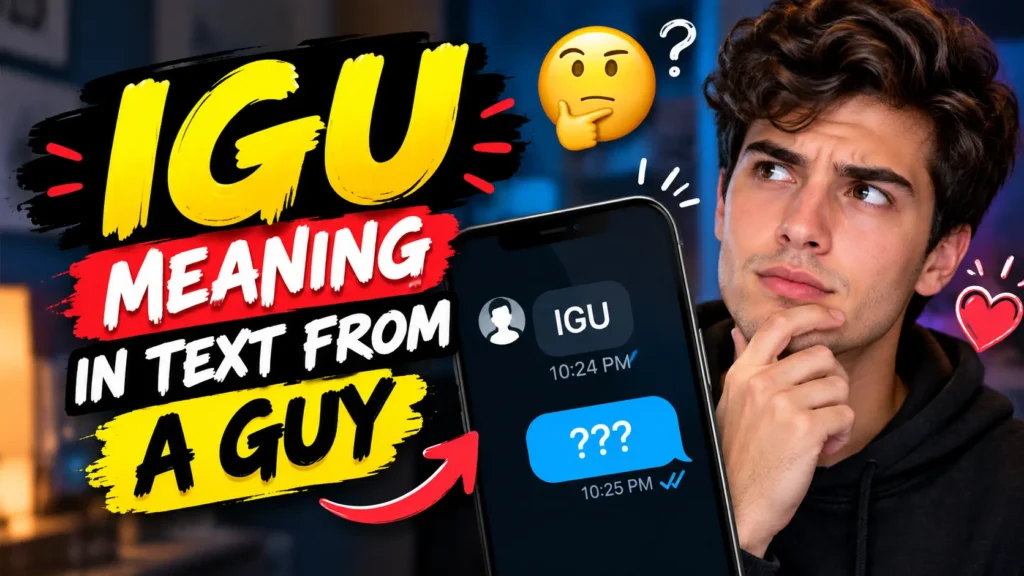
When a guy texts “IGU,” he usually means “I Got You,” showing that he understands or supports you. It can also mean that he will handle something or help you with it. The exact meaning depends on the conversation and his tone.
IGU Meaning Text Instagram
On Instagram, IGU commonly means “I Got You.” People use it in DMs or comments to show support, agreement, or that they understand what someone means. For example, “Don’t worry, IGU” can mean “Don’t worry, I got you.”
IGU Meaning Text Snapchat
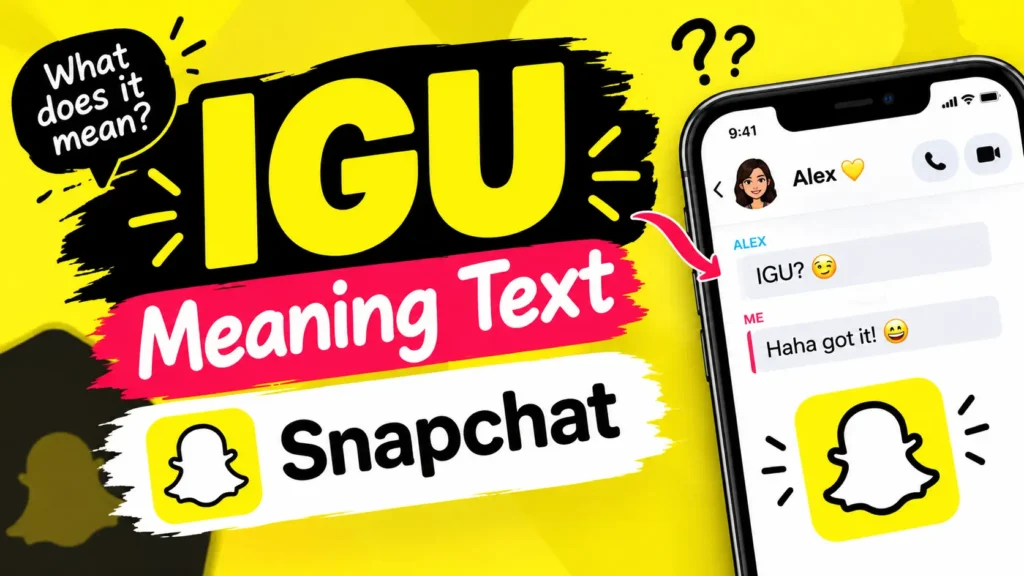
On Snapchat, IGU usually stands for “I Got You.” Someone may send it when they want to reassure you, offer help, or let you know they understand. Its meaning can change slightly depending on the context of the Snap or chat.
What Does IGU Mean on TikTok?
On TikTok, IGU most often means “I Got You.” Users may use the abbreviation in comments, captions, or private messages when agreeing to help or support someone. It is a casual texting expression that keeps the message short and easy to understand.
IGU Meaning From a Girl

When a girl says “IGU,” she usually means “I Got You.” She may be showing that she understands your situation, supports you, or is willing to help. In a friendly conversation, it can simply be a quick way to say that she has your back.
Does IGU Mean I Got You?
Yes, IGU commonly means “I Got You” in texting and social media conversations. It can express understanding, reassurance, support, or a willingness to help someone. However, the exact meaning should always be understood from the context of the conversation.
How IGU Developed in Online Communication
The origin of IGU isn’t tied to one universally documented creator or launch date. Like many texting abbreviations, it fits into the broader evolution of digital communication, where people shortened familiar phrases for faster interaction.
Text messaging helped establish a culture of compact expressions. Earlier SMS communication encouraged users to conserve characters and type quickly. As messaging platforms developed, abbreviated phrases continued to thrive even when character limits became less important.
The result is a flexible form of online language that includes familiar expressions such as:
- LOL — Laughing Out Loud
- BRB — Be Right Back
- OMG — Oh My God
- IDK — I Don’t Know
- IMO — In My Opinion
- ILY — I Love You
- TBH — To Be Honest
- FR — For Real
- IRL — In Real Life
- IKR — I Know, Right
IGU belongs to this wider world of text abbreviations, although it isn’t as universally standardized as some older abbreviations.
The evolution of internet culture also explains why the same abbreviation can develop different meanings in separate communities. A phrase used in a gaming chat might carry a different meaning from the same letters appearing in a casual conversation.
That’s why online communication requires interpretation rather than simple letter matching.
Why People Prefer Using IGU Instead of Full Sentences

Typing “I got you” takes only a few more keystrokes than “IGU.” So why shorten it?
The answer isn’t just speed. Texting is conversational.
People often type the way they talk. A three-letter abbreviation can feel lighter and more spontaneous than a complete sentence.
Compare:
“I understand. I will take care of it.”
with:
“IGU 👍”
The first sounds clear and deliberate. The second feels quick, relaxed, and familiar.
Benefits of Using IGU
Using IGU can provide several advantages in the right setting:
- Faster communication: You can send a short response without typing a full sentence.
- Concise communication: It expresses a familiar idea with very few characters.
- Casual tone: It fits relaxed conversations with people you know.
- Quick acknowledgment: It can show that you’ve received and understood a request.
- Supportive tone: When used as “I Got You,” it can reassure someone.
- Social connection: Shared slang can make conversations feel more natural.
- Conversational language: It resembles the shorthand people naturally develop in close relationships.
Still, brevity has a trade-off. A short expression can also create ambiguity.
That matters especially when IGU could mean either “I Got You” or “I Give Up.”
How IGU Is Used in Different Contexts
The meaning of IGU changes with the situation. Rather than memorizing one definition, look at the intention behind the message.
IGU as a Promise to Help
When someone asks for assistance, IGU can mean “I Got You” in the sense of “I’ll help.”
For example:
“Can you help me move these boxes?”
“IGU.”
The response communicates willingness to help.
Example
A: “Can you pick me up after work?”
B: “IGU. Just text me when you’re ready.”
Here, IGU expresses support, cooperation, and commitment.
IGU as a Sign of Understanding
Sometimes IGU works more like “I understand you” or “I get what you’re saying.”
A: “I don’t want to argue. I just need some time.”
B: “IGU.”
The response acknowledges the person’s feelings without necessarily agreeing with every detail.
Example
A: “This has been a really stressful week.”
B: “IGU. Take some time for yourself.”
Here, the phrase carries an empathetic and reassuring tone.
IGU as an Expression of Agreement
In some conversations, “I got you” can function as confirmation.
A: “Let’s meet at 7 instead.”
B: “IGU.”
The intended meaning is close to “Okay, that works.”
However, don’t assume IGU always means complete agreement. Someone can understand your position without agreeing with it.
Example
A: “I think we should leave early.”
B: “IGU. I’ll be ready at 6.”
Here, the response confirms the plan.
IGU as a Commitment to Take Action
Another common use involves taking care of something.
A: “Can you send the presentation to Sarah?”
B: “IGU.”
The implied meaning is “I’ll send it” or “I’ll handle it.”
Example
A: “Someone needs to make the final slides.”
B: “IGU. I’ll finish them tonight.”
This version emphasizes follow-through and responsibility.
IGU as a Casual Response
Sometimes IGU simply works as a quick response in an informal exchange.
“Thanks for covering my shift.”
“IGU.”
The phrase creates a relaxed, friendly interaction.
Still, if the message could be misunderstood, a full sentence is better.
IGU Meaning on Snapchat
The IGU meaning on Snapchat generally depends on the same conversational clues found elsewhere. Snapchat encourages quick, spontaneous messaging, so short expressions naturally fit its communication style.
Someone might send IGU in a Snap or chat after you ask for help.
Snapchat Example
“Can you send me that picture?”
“IGU 📸”
The likely meaning is “I got you. I’ll send it.”
If the conversation involves frustration, however, the interpretation can change:
“I’ve tried this filter ten times. IGU 😭”
Here, IGU may mean “I give up.”
The emoji and surrounding message make the second interpretation much easier to recognize.
IGU Meaning on Instagram
The IGU meaning on Instagram can appear in DMs, story replies, comments, or informal conversations.
Instagram culture relies heavily on concise communication. Users often mix abbreviations, emojis, reactions, and short phrases.
Example
Story reply: “Can you tag me in the post?”
Reply: “IGU ❤️”
Here, the phrase likely means “I got you.”
The red heart adds warmth. It doesn’t change the abbreviation’s basic meaning, but it can strengthen its affectionate or supportive tone.
In a comment section, however, IGU may be harder to interpret because there may be less conversational context.
IGU Meaning on TikTok
The IGU meaning on TikTok follows the same general principle: context determines intent.
TikTok comments can be extremely short because users often respond to a viral video, creator, tutorial, trend, or another comment without writing a full explanation.
Common TikTok Uses
You might encounter IGU when someone is:
- Offering help
- Confirming something
- Agreeing with another user
- Showing understanding
- Responding to a request
- Supporting a creator or friend
- Participating in a community interaction
Example
Comment: “Can someone explain how to do this?”
Reply: “IGU. I’ll make a tutorial.”
Here, the phrase clearly signals willingness to help.
If someone comments:
“This challenge is impossible. IGU 😭”
the meaning may instead be “I give up.”
IGU Meaning on WhatsApp
The IGU meaning on WhatsApp can appear in personal chats, family chats, coworker conversations, and community groups.
Because WhatsApp often supports longer-running conversations, context is usually easier to find than in a standalone social media comment.
Example
“Can you grab some groceries on your way home?”
“IGU.”
This means:
“I got you. I’ll take care of it.”
In a family chat, the abbreviation may feel perfectly natural. In a workplace group, however, clarity matters more.
IGU Meaning on Facebook and Messenger
On Facebook Messenger, IGU can work as a quick response to everyday requests.
Typical Uses
People may use it while:
- Confirming plans
- Offering help
- Sending information
- Coordinating an event
- Responding to friends
- Managing group chats
- Helping family members
For example:
“Can you remind everyone about dinner?”
“IGU.”
The intended meaning is likely “I got you. I’ll remind them.”
IGU Meaning Across Platforms
| Platform | Common Location | Likely Context | What to Check |
| Snapchat | Chats and Snaps | Quick responses | Previous message and emojis |
| DMs, comments, story replies | Casual interaction | Conversation context | |
| TikTok | Comments and messages | Community interaction | Comment thread |
| Personal and group chats | Everyday communication | Earlier messages | |
| Comments and messages | Social interaction | Relationship and topic | |
| Messenger | Private and group chats | Plans and assistance | Surrounding messages |
| Discord | Gaming chats and communities | Teamwork or casual talk | Gaming context |
| X (Twitter) | Replies and DMs | Short public conversations | Reply thread |
| SMS | Text messages | Personal communication | Previous text |
These platforms don’t create separate definitions for IGU. The same abbreviation can appear across them while retaining its context-dependent nature.
Real-Life Examples of IGU in Conversations
Friend-to-Friend Example
Alex: “Can you save me a seat?”
Sam: “IGU 👍”
Here, IGU means “I got you.”
Relationship Example
Partner: “I’m nervous about tomorrow.”
Partner: “IGU ❤️”
In this context, the phrase can express reassurance, emotional support, and connection.
The heart may add an affectionate tone, but IGU itself doesn’t automatically mean romantic interest.
Family Example
Mom: “Can you pick up groceries?”
Son: “IGU.”
The message means “I’ll take care of it.”
Student Example
Student A: “Can you send me today’s notes?”
Student B: “IGU.”
The phrase communicates a simple commitment to share the notes.
Workplace Example
Coworker: “Can you review these slides before the meeting?”
Coworker: “IGU.”
This can work in an informal coworker chat. However, professional communication may benefit from greater clarity:
“Sure. I’ll review them before the meeting.”
The second version removes ambiguity and sounds more professional.
Mini Case Study: How IGU Prevents Long Conversations
Imagine a friend sends this message:
“I’m stuck at the store and my phone is almost dead. Can you pick me up?”
A long response might say:
“Yes, don’t worry. I’ll come get you. Just let me know when you’re outside.”
A shorter reply could be:
“IGU. 👍”
In a relationship where both people already understand this shorthand, the abbreviated response can communicate the same basic commitment.
That’s the appeal of communication efficiency.
However, imagine receiving only:
“IGU.”
with no previous context.
You might reasonably wonder whether the person means:
- “I got you.”
- “I get you.”
- “I give up.”
- Something specific to your shared conversation.
That’s the central limitation of short internet slang: brevity depends on shared context.
When Should You Use IGU?
Use IGU when the conversation is clearly informal and the other person is likely to understand the abbreviation.
Great Situations for IGU
IGU works well in:
- Casual conversations
- Text messages
- Friend-to-friend communication
- Group chats
- Social media DMs
- Gaming chats
- Online communities
- Informal family communication
- Casual social media comments
It works especially well when someone asks for help or confirmation.
“Can you send that later?”
“IGU.”
Simple. Fast. Clear enough in context.
Benefits
The main advantages include:
- Faster typing
- Short responses
- Quick acknowledgment
- Casual communication
- Friendly tone
- Supportive attitude
- Efficient communication
- Less need for a lengthy explanation
Still, the best slang is slang that both people understand.
When You Should Avoid Using IGU
IGU isn’t appropriate for every setting.
Avoid IGU In
Avoid relying on the abbreviation in:
- Academic essays
- Formal reports
- Business proposals
- Professional legal documents
- Official communications
- Job applications
- Formal emails
- Client-facing messages
- Important workplace instructions
For example, instead of:
“IGU, I’ll handle the report.”
write:
“I understand. I’ll handle the report.”
Professional communication rewards precision. A three-letter abbreviation isn’t worth creating confusion.
Better Alternatives
Depending on the intended meaning, you can write:
| Instead of IGU | Clear Alternative |
| IGU | I understand |
| IGU | I got you |
| IGU | I’ll take care of it |
| IGU | I’ll handle it |
| IGU | I can help |
| IGU | That works |
| IGU | Consider it done |
| IGU | I understand what you mean |
Choose the alternative that matches your actual intention.
Is IGU Appropriate for Professional Communication?
Usually, no.
A close coworker might understand IGU immediately in a casual team chat. Yet the same abbreviation could look too informal in a message to a client, manager, recruiter, or unfamiliar business contact.
Consider these two messages:
“IGU, I’ll review the contract.”
and:
“Understood. I’ll review the contract and send my feedback by Friday.”
The second message communicates the same basic commitment while removing uncertainty.
Professional communication should prioritize clarity, accountability, and complete meaning.
How to Tell What Someone Means by IGU
When you’re unsure about the IGU text meaning, don’t guess immediately.
Use these clues:
- Read the message before IGU.
A request for help points toward “I Got You.” A frustrating situation may point toward “I Give Up.” - Look at the surrounding messages.
A single abbreviation can be ambiguous while a full conversation usually isn’t. - Check the tone.
Emojis such as 😩 or 😭 may signal frustration. 👍 or ❤️ may reinforce a positive or supportive reading. - Consider your relationship.
Friends often use shorthand that coworkers or strangers wouldn’t. - Look at the platform.
A gaming chat can create different expectations from a formal work conversation. - Consider the action being discussed.
Requests such as “send this,” “pick me up,” or “save a seat” make “I got you” especially plausible. - Ask if necessary.
If the meaning genuinely isn’t clear, simply ask what they meant.
IGU vs Similar Texting Abbreviations
Understanding similar expressions makes the IGU slang meaning easier to recognize.
IGU vs ILY
ILY means “I Love You.”
IGU and ILY can both appear in warm conversations, but they communicate different things.
- IGU: support, understanding, help, or confirmation
- ILY: affection or love
I Got You vs I Love You isn’t a direct comparison of synonyms. One expresses support or action, while the other expresses affection.
IGU vs IMO
IMO means “In My Opinion.”
The difference is straightforward:
- IGU: “I got you” / context-dependent support or acknowledgment
- IMO: “In my opinion”
Example:
“IMO, we should leave early.”
That’s an opinion, not a promise to help.
IGU vs TBH
TBH means “To Be Honest.”
TBH introduces honesty or a candid opinion:
IGU generally doesn’t introduce an opinion. Instead, it can acknowledge, support, reassure, or confirm.
IGU vs FR
FR means “For Real.”
It’s often used to emphasize sincerity or agreement.
“That movie was amazing.”
“FR.”
IGU can also communicate agreement in some contexts, but it carries a different core idea when used as “I Got You.”
IGU vs Bet
Bet is an informal way to communicate acceptance, agreement, or confirmation.
“Meet at 8?”
“Bet.”
IGU can also confirm a plan:
“Meet at 8?”
“IGU.”
But Bet is closer to “okay,” “sure,” or “deal,” while I Got You can emphasize support or willingness to handle something.
Example
| Expression | General Meaning | Main Function |
| IGU | I Got You / I Give Up | Support, acknowledgment, or surrender depending on context |
| ILY | I Love You | Affection |
| IMO | In My Opinion | Personal viewpoint |
| TBH | To Be Honest | Candid statement |
| FR | For Real | Emphasis or agreement |
| Bet | Okay / Deal | Acceptance or confirmation |
Common Misunderstandings About IGU
Assuming IGU Always Means Agreement
This is one of the easiest mistakes to make.
“I got you” doesn’t necessarily mean “I agree with everything you said.”
It may simply mean:
“I understand.”
Or:
“I’ll help.”
Those ideas are related to agreement but aren’t identical.
Ignoring Conversation Context
The surrounding messages are often the biggest clue.
Compare:
“Can you send the file?”
“IGU.”
with:
“I’ve been trying to fix this for three hours.”
“IGU 😩”
The first sounds like “I got you.”
The second could mean “I give up.”
Misreading Tone
Text removes facial expressions and vocal cues. As a result, short messages can feel more ambiguous than spoken conversations.
An emoji can provide extra information.
For example:
- IGU ❤️ — warmer or affectionate
- IGU 👍 — confirmation or acknowledgment
- IGU 😭 — potentially frustration or playful defeat
- IGU 😩 — potentially “I give up” or exhaustion
These aren’t strict rules. They’re clues.
Confusing Acronyms
Not every three-letter abbreviation follows the same pattern.
If you see an unfamiliar use of IGU, don’t automatically assume it means “I Got You.” Current slang references document multiple interpretations, which makes contextual reading particularly important.
How to Respond When Someone Says IGU
Your response should match what you believe the sender means.
Appreciative Responses
If IGU means “I got you” and they’re offering help, you can say:
- Thanks!
- I appreciate it.
- Thank you so much.
- You’re the best.
Friendly Responses
For casual conversations:
- Awesome
- Perfect
- Great
- Cool
- Nice
- Sounds good
Follow-Up Responses
If the person has agreed to handle something, continue with useful details:
“Thanks! Can you send it before 6?”
Or:
“Perfect. I’ll meet you there.”
This turns a short acknowledgment into clear coordination.
Casual Responses
Sometimes nothing more is necessary.
“IGU.”
“Thanks 👍”
That’s enough for a simple exchange.
If you’re uncertain whether IGU means “I Got You” or “I Give Up,” ask:
“Do you mean you got me or you’re giving up?”
It may sound slightly direct, but it’s better than responding to the wrong meaning.
Why IGU Remains Popular in Internet Culture
Short abbreviations survive because they solve a simple communication problem: people want to express familiar ideas quickly.
It Saves Time
Typing a few characters takes less effort than writing a full sentence. In fast-moving chats, that convenience adds up.
It Sounds Positive
When used as “I Got You,” the phrase can communicate a supportive tone, reassurance, and willingness to help.
That makes it useful when someone needs encouragement or assistance.
It Works Across Platforms
You may encounter IGU in:
- SMS
- Snapchat
- TikTok
- Facebook Messenger
- Discord
- X
- Group chats
- Gaming communities
- Online forums
The platform doesn’t necessarily change the definition. Instead, the communication setting influences how readers interpret it.
It Creates Social Connection
Shared slang can function like conversational shorthand between people who understand the same online language.
A phrase such as “IGU ❤️” can carry more social warmth than a formal sentence because it feels spontaneous and familiar.
That’s one reason internet slang continues to shape modern digital conversations.
Key Takeaways About IGU
The IGU meaning is simple in some situations but surprisingly context-dependent in others.
The most useful texting interpretation is:
IGU = “I Got You.”
In this sense, it can communicate:
- I understand you
- I will help you
- I’ll handle it
- I support you
- Don’t worry about it
- I’ve got your back
- Okay, understood
- Yes, that works
However, IGU can also mean “I Give Up” in casual online usage. That interpretation usually appears when someone is frustrated, defeated, or jokingly surrendering.
So when someone sends IGU, don’t interpret it in isolation. Read the conversation first.
Conclusion
The IGU meaning in text usually points to “I Got You” when someone is offering support, confirming a request, showing understanding, or promising to take care of something. It’s a compact form of informal communication that fits naturally into texting, DMs, group chats, and social media conversations.
Yet IGU isn’t completely standardized. “I Give Up” is another documented slang interpretation, especially when the conversation involves frustration or defeat.
FAQs
What does IGU mean in text messages?
IGU commonly means “I Got You” in casual text messages. It can express support, understanding, reassurance, agreement, or willingness to help. However, IGU can also mean “I Give Up” when someone is frustrated or defeated.
Is IGU a positive slang term?
When IGU means “I Got You,” it usually has a positive, supportive, friendly, or reassuring tone. It can tell someone that you understand them or will help them.
When it means “I Give Up,” the tone can become frustrated, tired, defeated, or playful.
Where is IGU commonly used online?
IGU may appear in text messages, Snapchat, Instagram DMs, TikTok comments, WhatsApp chats, Facebook Messenger, Discord, gaming chats, and other informal online conversations.
Its meaning doesn’t automatically change from one platform to another. The surrounding conversation remains the most useful clue.
Can IGU have different meanings?
Yes. In current online slang references, IGU can mean “I Got You” or “I Give Up.” Context determines which interpretation makes sense.
Outside slang, IGU can also represent unrelated technical terms, such as Insulated Glass Unit.
Why has IGU become popular?
Short abbreviations fit the speed of modern digital communication. They let people acknowledge requests, offer help, or express a reaction without typing a lengthy explanation.
The casual style also fits the conversational nature of messaging apps and social media.
What does IGU mean in chat?
In a supportive chat, IGU usually means “I Got You.” Depending on the context, that can mean “I understand,” “I’ll help,” “I’ll handle it,” or “Don’t worry.”
If the conversation centers on frustration or defeat, IGU may instead mean “I Give Up.”
How can you tell which IGU meaning someone intends?
Look at the message before IGU, the overall conversation, the person’s tone, emojis, and what they are responding to.
A request such as “Can you pick me up?” strongly supports the “I Got You” interpretation. A message about failing repeatedly may point toward “I Give Up.”
Is IGU formal language?
No. IGU is best treated as casual online slang. Use complete sentences in academic essays, formal reports, business proposals, legal documents, official communications, and other situations where clarity and professionalism matter.